# Introduction
**Vaultedge is a decentralized borrowing protocol that enables users to borrow against a wide range of assets, including blue-chip tokens, liquid staked asssets, vault tokens & much more.**
When users deposit assets into Vaultedge, they continue to earn the rewards they would normally receive, without needing to actively manage their position.
Users borrow [USDVE](/the-protocol/usdve) (an over-collateralized USD stablecoin). They can use the USDVE to purchase additional assets, hedge their position, or provide liquidity for additional rewards.
Vaultedge offers **zero interest** loans against yield generating collateral, enabling the best experience and capital efficiency for leveraging and self-repaying positions. During periods of high utilization or market stress, a temporary borrowing rate may apply to maintain protocol stability.
# General
### What is Vaultedge?
Vaultedge is a decentralized borrowing protocol that enables users to borrow against a wide variety of assets.
Users borrow [USDVE](/the-protocol/usdve), a USD-pegged stablecoin, and require a maximum Loan to Value. Which depends on the value of the collateral, for some assets can get as high as 95% LTV.
Vaultedge will support borrowing against:
* Blue-chip assets (e.g., WETH, WBTC)
* Stablecoins (e.g., USDC, USDT)
* Staked assets (e.g., wstETH, weETH)
* Vault receipt tokens (e.g., Morpho or Aave receipt tokens)
* Liquidity Provider (LP) tokens
* Real world assets (RWAs)
The USDVE stablecoin is decentralized, over-collateralized, and backed by the value of users' collateral positions.
The only way to mint USDVE is by depositing collateral into the Vaultedge protocol.
**Vaultedge is decentralized and completely non-custodial.**
## How does Vaultedge work?
Users deposit whitelisted crypto-assets (e.g., wETH) as collateral into a smart contracts called [Vault](/the-protocol/borrowing/vaults), allowing them to mint USDVE.
In order to avoid liquidation, vaults must maintain a required Minimum Collateral Ratio (MCR) determined by the Vaultedge data-driven [risk methodology](/the-protocol/borrowing/risk-methodology).
In addition to the collateral, the loans are secured by the [Stability pool](/the-protocol/borrowing/stability-pool), which contains USDVE tokens staked by fellow borrowers who act as guarantors.
### Why should I use Vaultedge?
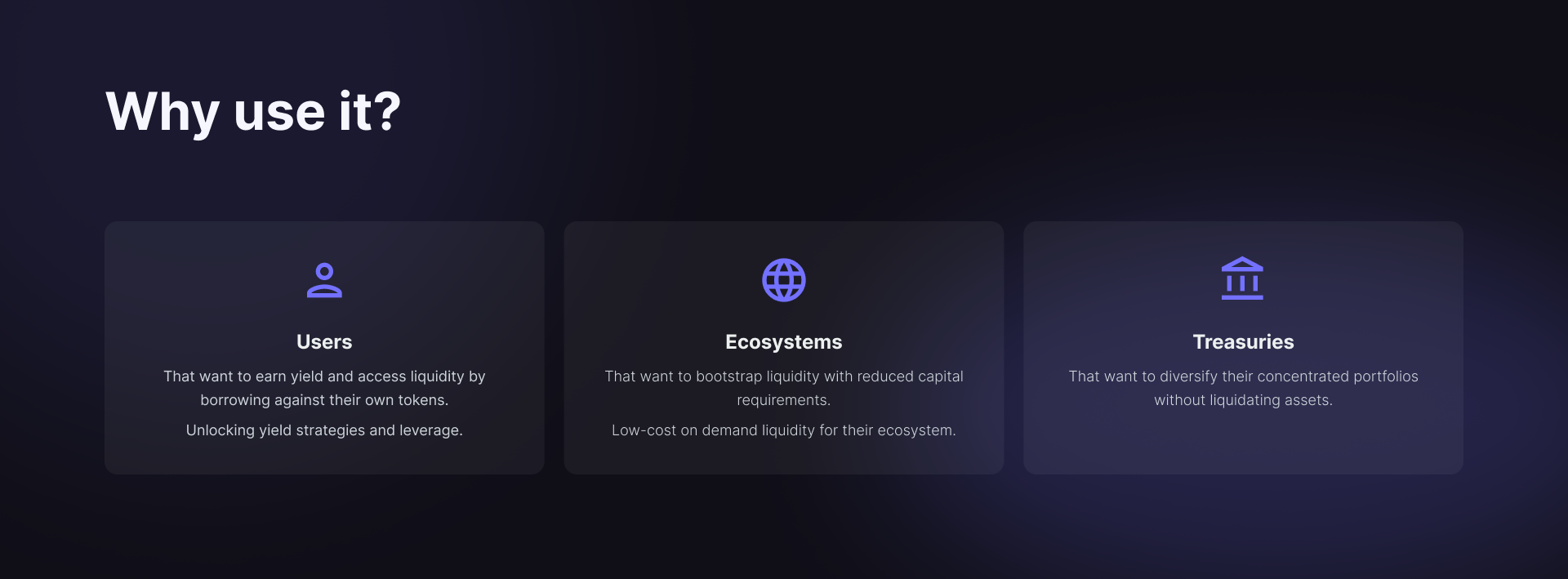
The Vaultedge protocol solves critical problems for users and protocols :
* **On-demand, low-cost liquidity** by borrowing against a wide range of tokens at zero interest rate
* **Unlock liquidity on your illiquid assets** by borrowing against locked or illiquid tokens
* **Deep liquidity on DEXs** without the need to incentivize or pay the other side of the liquidity pools
* **Treasuries management** with smart capital allocation
* **Earn yield on your USDVE by** depositing in the stability pool and earn a share of the liquidations
# Terminology
**Vault:**
A user may deposit an assets and open a Vault. It is used as backing to mint and withdraw USDVE.
**Debt:**
The amount of USDVE you have minted against the collateral in your vault.
**Issuance Fee:**
This is a one-time fee when collateral is deposited into Vaultedge. The fee amount varies depending on USDVE borrowed & collateral type.
**Collateral Ratio:**
The Collateral Ratio is the proportion of the total value of the Collateral to the total Value of the Borrowed amount. It is expressed as a percentage and indicates the degree to which the collateral backs the borrowed amount.
$$
CR = \left( \frac{CV}{BV} \right) \cdot 100
$$
A higher Collateral Ratio means that the borrower has more collateral relative to the borrowed amount, which reduces the risk for the protocol.
#### Loan to Value (LTV) Ratio
The LTV ratio, on the other hand, is the proportion of the total value of the borrowed amount to the total value of the collateral. It is also expressed as a percentage and indicates the degree to which the borrowed amount is covered by the collateral.
$$
LTV = \left( \frac{BV}{CV} \right) \cdot 100
$$
A lower LTV ratio implies a safer position for the borrower, as it means that they have more collateral relative to the borrowed amount, reducing the risk of liquidation.
**Individual Collateral Ratio (ICR):**
The **Individual Collateral Ratio** refers to the specific ratio of a borrower’s collateral value to their debt. This determines how secure a single vault position is.
$$
{Individual Collateral Ratio} = \frac{\text{ Vault's Collateral Value }}{\text{Debt in vault}}
$$
**Example:**\
If I deposit 1,000 AERO, priced at $2.75, the collateral value is $2,750.\
If I borrow 2,000 USDVE:
$$
{Individual Collateral Ratio} = \frac{2750 , \text{CV}}{2000 , \text{USDVE}} = 137.5%
$$
**Minimum Collateral Ratio (MCR):**
The **Minimum Collateral Ratio** is the lowest ratio at which debt can be issued in a vault. No Vault can be created below the MCR. If a Vault ICR falls below the MCR, it is now eligible for discounted redemption and potentially be liquidated.
{% hint style="warning" %}
Debt can't be issued when a vaults ICR is below the MCR
{% endhint %}
**Critical Collateral Ratio (CCR):**
The **Critical Collateral Ratio (CCR)** sets the ICR threshold at which a vault becomes eligible for Discounted redemption or liquidation by the [Stability Pool.](/the-protocol/borrowing/stability-pool) (Provided there is sufficient liquidity in the Stability Pool to cover the debt.)
The CCR represents the threshold below which a specific collateral type enters[ recovery mode.](/the-protocol/borrowing/recovery-mode)
{% hint style="danger" %}
When CR is below the CCR, the vault enters recovery mode.
{% endhint %}
**Liquidation reserve:**
When you open a Vault and draw a loan, 1 USDVE are set aside as a way to compensate gas costs for the transaction sender in the event your Vault being liquidated. The Liquidation Reserve is fully refundable if your Vault is not liquidated, and is given back to you when you close your vault by repaying your debt. The Liquidation Reserve counts as debt and is taken into account for the calculation of a vault collateral ratio, slightly increasing the actual collateral requirements.
**Backing Percent:**
How much of the protocol is backed by that particular asset. If the system has collateral valued of $1,000,000 and it has $200,000 of AERO, then it has 20% backing percent of AERO.
**Recovery Mode:**
Recovery Mode kicks in when the total **CR** of one specific collateral type goes **below the CCR.**
***During Recovery Mode, vaults with an ICR below the CCR can be liquidated.***
### Other Useful Definitions
**Stablecoin** - Stablecoins are cryptocurrencies that are designed to be stable in price. Often times their market values will be pegged to some external reference such as the US dollar.
**Peg** - When something is pegged, it means that it is fixed to an amount at a particular level. For example, USDVE is pegged to 1 USD and should remain fixed to the price of 1 USD.
**Annual percentage rate (APR)** - APR is expressed as a percentage that represents the monetary value or reward that investors are expected to earn. This includes any fees or additional cots associated, but does not take compounding into account.
**Staking** - Staking is the process of locking up tokens in exchange for rewards for securing a protocol. By staking your assets, you support the blockchain network and help confirm transactions.
**Arbitrage** - Arbitrage is the process of purchasing and selling the same asset in different markets in order to profit from the difference in the listed prices. By profiting through exploiting market inefficiencies, it inadvertently resolves the price in different markets.
**High-risk collateral** - High-risk collateral refers to assets with high price volatility or low liquidity. These collateral types will have a higher **MCR & CCR** assigned to them because liquidation risk are higher due to fluctuations in price.
[ ](https://techdocs.yeti.finance/how-does-yeti-finance-work/recovery-mode)
# Borrowing
Zero-interest borrowing
### Why borrow with Vaultedge:
With **Minimum Collateral Ratios (MCR)** as low as **100.5%**, Vaultedge enables greater capital efficiency than most borrowing systems. This means users can access more liquidity using less collateral, without paying recurring interest under normal conditions.
Vaultedge’s architecture is designed around **isolated collateral markets**, allowing for optimized parameters per asset and supporting a broader range of collateral types, including **veTokens, LP tokens**, and **Liquid Staked Assets**.
Instead of selling tokens for liquidity, users or protocols can deposit them into Vaultedge and **borrow USDVE**, a USD-pegged stablecoin, against their holdings.
Vaultedge also offers a powerful solution for **veToken holders**, allowing them to **access their future yield upfront** by borrowing today.
{% hint style="info" %}
Under normal conditions, **there is no recurring interest and no repayment deadline**, provided your vault maintains the required collateral ratio. During periods of high utilization, a temporary borrowing rate may apply as part of the protocol's stability mechanism.
{% endhint %}
### Borrowing process:
Borrowing with Vaultedge is simple once you understand the key components:
1. **Open a Vault**\
Choose an asset from the list of supported collateral types and deposit it to open an isolated vault.
2. **Mint USDVE**\
You can borrow USDVE as long as your **Individual Collateral Ratio (ICR)** remains above the **Minimum Collateral Ratio (MCR)** for that asset.\
For example, if the MCR is 110%, you can borrow up to approximately 90.9% of your collateral’s value.
3. **Issuance Fee and Liquidation Reserve**\
When minting USDVE, an **issuance fee** is applied. This varies depending on the collateral type and its backing percentage in the system.
{% hint style="info" %}
Additionally, **1 USDVE** is reserved as a **liquidation reserve**, which covers gas costs in the event of liquidation. This reserve is **fully refundable** when you repay your debt and close your vault.
{% endhint %}
4. **Withdraw Collateral Anytime**\
To unlock your collateral, simply repay your USDVE debt. Until then, the collateral remains locked in Vaultedge smart contracts as backing for the issued USDVE.
### Liquidation Mechanics
If the value of your collateral decreases, your **ICR** may fall below safe thresholds, putting your vault at risk of liquidation.
To manage system risk, Vaultedge operates under two modes:
#### Normal Mode
This is the default state of the protocol.\
Vaults are eligible for liquidation if their **ICR < MCR.**
#### Recovery Mode
Recovery Mode is triggered if the **Total Collateral Ratio (TCR)** for a specific collateral type falls below the **Critical Collateral Ratio (CCR).**\
In this state, vaults are eligible for liquidation if:
* **ICR < CCR**
The TCR can be monitored on the Dashboard under “System Collateral Ratio.”
### How can I earn money on Vaultedge?
Users can earn money on Vaultedge by providing liquidity to the Stability Pool.
The Stability Pool is used to help repay the debts of liquidated vaults that go below the MCR.
Stability Providers earn income via liquidation gains.
# Vaults
A Vault is a smart contract used to issue and manage USDVE loans.
### What Are Vaults?
A **Vault** is where you can deposit a supported collateral asset in order to borrow **USDVE**, Vaultedge’s native USD pegged stablecoin.
Each Vault maintains two balances:
* The deposited **collateral**
* The corresponding **debt** in **USDVE**
You can adjust these balances by adding collateral, repaying debt, or minting more USDVE (as long as your vault remains above the required collateral ratio). As these values change, your **Individual Collateral Ratio (ICR)** also updates.
You can close your Vault at any time by repaying your entire debt. Even during **Recovery Mode**, repayment is allowed.
However, only actions that increase the **Total Collateral Ratio (TCR)** are permitted while the system is in Recovery Mode.
### Vault Status
Once a Vault is opened, Vaultedge classifies its status as:
* **Inactive**: No USDVE has been borrowed yet.
* **Active**: USDVE has been minted and the vault is not subject to liquidation or redemption.
* **Redeemed**: The vault was partially repaid by a third party due to low ICR under redemption conditions.
* **Liquidated**: The vault was forcibly closed due to falling below the **Minimum Liquidation Ratio (MLR)** or **Adjusted ICR** thresholds.
### Collateral Ratios
Understanding Vaultedge’s safety metrics is essential for managing risk:
#### Collateral Ratio (CR)
The **Collateral Ratio** represents the ratio of the total collateral value to the total borrowed amount.
$$
Collateral Ratio = \left( \frac{CV}{BV} \right)
$$
A higher CR indicates a more secure position for the protocol.
#### Loan to Value Ratio (LTV)
The **LTV Ratio** is the inverse of CR and shows the percentage of debt relative to the collateral value:
$$
LTV = \left( \frac{BV}{CV} \right)
$$
A lower LTV means less risk of liquidation.
#### Individual Collateral Ratio (ICR)
The **ICR** reflects your personal Vault's safety, measuring how well your own collateral covers your debt:
$$
ICR = \left( \frac{\text{Collateral Value}}{\text{Debt}} \right)
$$
Vaults must maintain an ICR above the **Minimum Collateral Ratio (MCR)** to remain eligible for borrowing, and above the **Critical Collateral Ratio (MLR)** to avoid liquidation.
### Why Use Vaultedge?
#### 1. Capital Efficiency with Isolated Collateral
Vaultedge enables **borrowing with an MCR as low as 100.5%**, giving users more liquidity for less collateral. Yield bearing assets like LSTs, LP tokens, and veTokens continue earning while used as collateral.
For example, users can borrow USDVE against Liquid Staked ETH or governance locked assets without selling them.
Users may also **leverage their collateral** by using borrowed USDVE to buy more of the same asset, then depositing it again at their own risk.
#### 2. Vault Specific Risk Parameters
Each asset market has its own isolated risk profile. You can only borrow against **one collateral type per Vault**. To borrow against multiple assets, you need to open multiple Vaults.
Parameters per collateral ([read more](broken://pages/2gEHlfCSj5SQiUprbGiR))
#### 3. 0% Interest
Under normal conditions, Vaultedge charges no recurring interest on borrowed USDVE. Instead, a one-time issuance fee is applied based on the risk profile and system backing percent of the asset. During periods of high system utilization or market stress, a dynamic borrowing rate may temporarily apply to manage demand and maintain stability. This rate returns to 0% once conditions normalize.
> This fee model provides a more predictable borrowing experience compared to protocols with variable APRs
#### 4. Liquidation Reserve
Each time you borrow, **1 USDVE** is reserved to cover gas costs if your Vault is ever liquidated. This amount is fully refunded when you repay your debt and close the Vault.
The liquidation reserve counts as part of your debt and slightly increases your ICR requirement.
#### 5. Recovery Mode and System Safety
Specific markets can enter **Recovery Mode** when a collateral type’s **Total Collateral Ratio (TCR)** drops below its **Critical Collateral Ratio (CCR)**.
* **Normal Mode**: Vaults are only liquidated if **ICR** < **MCR**
* **Recovery Mode**: Vaults can be liquidated if:
* **ICR < CCR**, or
* **ICR < TCR**
In Recovery Mode, only actions that increase TCR are allowed. This includes repaying debt or adding collateral.
The TCR can be monitored on the Dashboard under “System Collateral Ratio.”
#### 6. Stable Peg and Redemptions
To maintain a stable peg for USDVE, Vaultedge supports a **Redemptions** and **discounted redemption mechanism**. Users can redeem USDVE directly against undervalued collateral, improving peg stability while redistributing risk to unsafe Vaults.
# Risk methodology
### Redemptions vs Liquidations
Vaultedge uses two distinct mechanisms to maintain collateralization and peg stability: **Redemptions** and **Liquidations**.
#### What is a Redemption?
A **Redemption** allows any USDVE holder to redeem their USDVE for collateral from the vaults with the **lowest collateral ratios** in the system. This reduces the supply of USDVE and helps maintain its peg close to one dollar.
Unlike a liquidation, redemptions do not require a vault to fall below the Minimum Liquidation Ratio (MLR). Instead, vaults are prioritized by their **Individual Collateral Ratio (ICR)**. The lower the ICR, the more likely that vault is to be redeemed against.
#### What Happens During a Redemption?
* A USDVE holder sends USDVE to the protocol and requests to redeem it for collateral
* The protocol identifies the vaults with the **lowest ICRs** and starts redeeming collateral from those vaults
* Collateral is transferred from the vaults to the redeemer
* The vault’s debt is reduced proportionally, improving its ICR
* The redeemed USDVE is burned
{% hint style="danger" %}
Vaults that are redeemed against **do not incur a net financial loss**, but the user **loses exposure to their collateral**.
{% endhint %}
This means they still hold their remaining USDVE, but they no longer hold the full amount of their originally deposited collateral.
#### How to Avoid Being Redeemed Against
The best way to avoid redemption is to maintain a **high ICR** compared to other vaults in the system. Vaults with the lowest ICR are first in line to be redeemed.
In the interface, Vaultedge displays a **Debt Ahead** metric, showing how much USDVE needs to be redeemed before your vault is impacted.
Vaultedge continuously updates collateral prices using a decentralized oracle network. If the **Individual Collateral Ratio (ICR)** of a vault falls below the required thresholds, it becomes subject to liquidation through a multi-stage automated process.
### Liquidation Flow
| ICR | Stage | Process |
| ------------------------------------------------- | --------------------- | ------------------------------------------------------------------------------------------------------------------------------- |
| **MCR > ICR > CCR** | Discounted Redemption | The vault enters the redemption queue. Anyone can redeem USDVE for the collateral at a small discount based on the vault's ICR. |
| **MCR > ICR** | Stability pool | the stability pool will repay the vaults' debt and receive the collateral [read more](/the-protocol/borrowing/stability-pool). |
| **MCR > ICR** & stability pool without liquidity | Redistribution | the redistribution mechanism will take place [read more](/the-protocol/borrowing/stability-pool). |
Once a vault falls below the **MCR**, it is considered **under-collateralized** and automatically sent into liquidation.
{% hint style="success" %}
The entire liquidation process is **fully automated and permissionless**, ensuring rapid execution without human intervention.
{% endhint %}
### What Are Liquidations?
Liquidation ensures that the supply of USDVE remains fully backed by collateral at all times. If a vault becomes unsafe by falling below the **Minimum Colalteral Ratio (MCR)**, the protocol takes the following actions:
* The vault is closed
* Its debt is absorbed by the **Stability Pool** (or redistributed if needed)
* Its collateral is transferred to **Stability Providers**
The **vault owner keeps their USDVE** but loses their collateral. They can no longer recover the collateral by repaying the loan.
{% hint style="danger" %}
**Liquidations result in a net loss for the vault owner.**
{% endhint %}
**Deppeg Mitigation Process:**
If **USDVE falls below $1**, the redemption mechanism is designed to incentivize buying pressure. Users can redeem USDVE for discounted collateral, which should restore demand and return USDVE to its peg.
However, if not enough vaults are eligible for redemption, and demand remains low, Vaultedge can dynamically raise the **Critical Collateral Ratio (CCR)**. This means more vaults with higher ICRs become redeemable.
Importantly, these redemptions **do not result in net losses** for the vaults being redeemed. Instead, they are treated as early partial repayments with collateral exchanged at a slight premium.
The **CCR** will continue to rise until redemption demand is sufficient to restore the peg.
# Stability pool
Maintaining USDVE peg
## What is the Stability pool?
The **Stability Pool** is the first line of defense that maintains solvency in the Vaultedge system. It provides the liquidity needed to absorb debt from undercollateralized vaults during liquidations, ensuring that the total supply of **USDVE** remains fully backed by collateral at all times.
Users who deposit USDVE into the Stability Pool are called **Stability Providers**. When a liquidation occurs, the protocol uses USDVE from the pool to repay the vault’s debt, and distributes the entire collateral from that vault to Stability Providers, **pro-rata**.
Since vaults are only liquidated when their **Individual Collateral Ratio (ICR)** falls below the **Minimum Collateral Ratio (MCR)**, liquidations are expected to result in a **net gain** for Stability Providers in most cases.
### How does it work?
When a vault is liquidated:
1. The debt owed by the vault is **burned** from the Stability Pool’s balance
2. The full collateral from the liquidated vault is **distributed proportionally** to all active Stability Providers
3. This process is fully **automatic and trustless**
Providers may receive any **whitelisted collateral** used in the protocol, depending on which vaults are liquidated.
You can withdraw any received collateral at any time and sell or swap it for USDVE to reduce your exposure. However, all Stability Providers are exposed to **all collateral types**, not just the ones they may have personally borrowed against.
### Why should i deposit USDVE to the Stability pool?
* You earn **liquidated collateral** at a discount
* Most liquidations occur with vaults just under the **MCR** threshold, making them **profitable in USD terms**
* There are **no lockups**, and you can withdraw your deposit (or your received collateral) anytime there are no pending liquidations
### What happens if the Stability Pool is empty when liquidations occur?
If the Stability Pool is depleted, Vaultedge triggers a **secondary liquidation mechanism** called **redistribution**.
In this case:
* The debt and collateral of liquidated vaults are redistributed across **healthy vaults** with the same collateral type
* Redistribution is done **proportionally** to each recipient vault’s collateral value
* This is less optimal than using the Stability Pool but ensures continued system solvency
### Can i withdraw my deposit whenever i want?
As a general rule, you can withdraw the deposit made to the Stability Pool at any time. There is no minimum lockup duration. However, you cannot withdraw while there are pending liquidatable vaults.
### Can i lose money by depositing funds to the Stability Pool?
While Stability Providers typically receive more collateral than the **USDVE** they lose, **losses are possible** under rare edge cases, including:
* **Flash crashes**, where a vault’s ICR drops below 100%
* **Oracle failures**, resulting in incorrect collateral pricing
* **USDVE trading above $1**, which could make the effective value of your burnt USDVE greater than the collateral received
However, in most market conditions, Stability Providers experience **net gains** and can swap their collateral back to USDVE at or above peg over time.
Losses are only realized if you **withdraw immediately after an adverse event** and **sell at unfavorable prices**.
# Redemptions
The first line of defense
## Redemptions
Redemptions are a core mechanism that maintains the USDVE peg by allowing anyone to exchange USDVE for underlying collateral at face value, minus a small fee.
{% hint style="info" %}
**For USDVE holders looking to exit:** Redemptions are not the most efficient way to convert your USDVE back to collateral. The redemption fee (0.5%+) and softening mechanism mean you receive less than face value. You should first check the **PSM (Peg Stability Module)** for 1:1 swaps or available **liquidity pools** (e.g., USDVE/USDC) for better rates. Redemptions exist primarily as a peg stability mechanism and should only be used when PSM liquidity is exhausted and pool rates are unfavorable.
{% endhint %}
### Redemptions Are Profitable for Borrowers
Unlike liquidations, redemptions are a **net positive event** for Vault owners. When your Vault is redeemed against, your debt is reduced by the full USDVE amount, but your collateral is only reduced by the softened amount (99.5% of fair value). You keep the 0.5% difference as profit.
In practice, this means someone else is paying down your loan for you, and you earn a small bonus for it.
**Example:** A borrower has a Vault with 10 ETH collateral and 15,000 USDVE debt. A redeemer exchanges 2,000 USDVE against this Vault (1 ETH worth at $2,000/ETH):
| | Before Redemption | After Redemption |
| ------------------------- | ----------------- | ----------------- |
| Collateral | 10.000 ETH | 9.005 ETH |
| Debt | 15,000 USDVE | 13,000 USDVE |
| Softening profit retained | - | 0.005 ETH (\~$10) |
The borrower's debt dropped by 2,000 USDVE but their collateral only dropped by 0.995 ETH. They kept 0.005 ETH (\~$10) as pure profit. Their net position actually improved.
#### Especially Valuable for Stablecoin Collateral
For borrowers using stablecoin collateral (like USDC), redemptions are even more attractive. Typical stablecoin yield in DeFi sits around 3-5% APY. A single redemption event delivers a 0.5% return on the redeemed portion instantly, which annualized far exceeds what most stablecoin strategies offer.
{% hint style="info" %}
If a stablecoin Vault gets redeemed against multiple times over the course of a year, the cumulative softening profits can significantly outperform passive stablecoin lending rates, all while the borrower's net position remains healthy and their debt is being paid down by third parties.
{% endhint %}
This makes holding a stablecoin-backed Vault with a competitive (lower) collateral ratio a deliberately attractive strategy. Rather than avoiding redemptions, some borrowers may welcome them as a yield source.
### How Redemptions Work
When USDVE trades below $1, an arbitrage opportunity is created. Users can buy discounted USDVE on the open market and redeem it for $1 worth of collateral through the protocol. This buying pressure pushes USDVE back toward its peg, while the redeemer keeps the difference as profit.
During a redemption, the protocol burns the redeemed USDVE, reducing the total debt supply. This strengthens the collateral backing per remaining USDVE, reinforcing the peg from both sides.
#### Which Vaults Get Redeemed?
Redemptions target the **lowest collateral ratio Vaults first**, but only those above the **Minimum Collateral Ratio (MCR) of 110%**. Vaults below 110% are handled by the liquidation mechanism instead and cannot be redeemed against.
The system works through Vaults in ascending order of collateral ratio:
| Vault | ICR | Redeemable? |
| ------- | ---- | --------------------------------------------- |
| Vault A | 108% | No - below MCR, liquidation candidate |
| Vault B | 112% | Yes - first redemption target |
| Vault C | 150% | Yes - only after Vault B is fully redeemed |
| Vault D | 250% | Yes - only after Vaults B and C are exhausted |
This ordering means that Vault owners with lower collateral ratios face higher redemption risk. To reduce your exposure to redemptions, maintain a higher collateral ratio relative to other Vaults in the system.
#### What Happens to a Redeemed Vault?
When your Vault is redeemed against, both your collateral and debt are reduced proportionally. You do not lose value in net terms. Your debt decreases by the redeemed USDVE amount, and your collateral decreases by the equivalent value (minus a small buffer you retain from softening).
If a Vault is only partially redeemed, it remains active with a reduced position. If fully redeemed, the Vault status changes to **Redeemed**.
### Collateral Split
When a redemption occurs, the collateral is split three ways between the Vault owner, the protocol, and the redeemer.
**Example: Redeeming 1 ETH worth of USDVE at a 0.81% fee rate**
| Recipient | Amount | Description |
| ------------------- | ----------------------- | ------------------------------------------- |
| Vault owner retains | \~0.005 ETH (\~0.5%) | Protective buffer from redemption softening |
| Protocol treasury | \~0.00806 ETH (\~0.81%) | Dynamic redemption fee |
| Redeemer receives | \~0.98694 ETH (\~98.7%) | Net collateral received |
The Vault owner's retained portion comes from **redemption softening** (set at 99.5%), which means only 99.5% of the fair-value collateral is made available for redemption. The remaining 0.5% stays in the Vault automatically. This is not a fee. It is a protective buffer for borrowers.
The **protocol fee** is separate from softening and is calculated on the softened amount (0.995 ETH in this example), not the full fair value. This fee is sent to the protocol treasury.
### Redemption Fee
The redemption fee is dynamic and adjusts based on system activity. It consists of two components:
**Redemption Fee = Fee Floor + Base Rate**
* **Fee Floor**: A minimum fee per collateral type, default 0.5%
* **Base Rate**: Starts at 0% and increases with each redemption, then decays back over time
#### How the Base Rate Changes
Each redemption increases the base rate by a small amount:
**Delta = (Value redeemed / Total system debt) / 2**
For example, redeeming 1 ETH ($2,000) against a system with $10M total debt:
* Delta = ($2,000 / $10,000,000) / 2 = 0.01%
* If the base rate was 0.30%, it becomes 0.31%
* Total fee = 0.5% floor + 0.31% base = **0.81%**
When multiple redemptions happen in quick succession, the base rate compounds:
| Redemption | Base Rate Before | Base Rate After | Total Fee |
| ---------- | ---------------- | --------------- | --------- |
| #1 | 0.30% | 0.31% | 0.81% |
| #2 | 0.31% | 0.32% | 0.82% |
| #3 | 0.32% | 0.33% | 0.83% |
This progressive increase discourages mass redemptions that could destabilize the protocol.
#### Time Decay
The base rate decays with a **12-hour half-life**. After a spike in redemption activity:
| Time Elapsed | Base Rate (starting at 2.0%) | Total Fee (with 0.5% floor) |
| ------------ | ---------------------------- | --------------------------- |
| 6 hours | \~1.40% | \~1.90% |
| 12 hours | \~0.98% | \~1.48% |
| 24 hours | \~0.48% | \~0.98% |
| 48 hours | \~0.12% | \~0.62% |
The fee never drops below the floor (default 0.5%).
#### Per-Collateral Fees
Each collateral type maintains its own independent base rate and fee floor. Redeeming against one collateral does not affect the fees of another.
| Collateral | Fee Floor | Current Base Rate (example) | Total Fee |
| ---------- | --------- | --------------------------- | --------- |
| WETH | 0.5% | 0.3% | 0.8% |
| WBTC | 0.5% | 0.1% | 0.6% |
| USDC | 0.5% | 0.0% | 0.5% |
If one collateral type has experienced heavy redemption activity, users may find it cheaper to redeem against a different, less active collateral market.
#### Where Do Fees Go?
Redemption fees are sent to the **protocol treasury**. In the future, governance may redirect fees to a staking pool.
### Managing Redemption Exposure
Vaults with the lowest collateral ratios above 110% are redeemed first. Depending on your strategy:
* **To attract redemptions** (and earn softening profits): Maintain a lower collateral ratio, closer to but safely above 110%. This positions your Vault earlier in the redemption queue.
* **To avoid redemptions**: Maintain a higher collateral ratio relative to other Vaults. The further above 110% you are, the less likely your Vault is targeted.
* **Monitor the system**. If many Vaults have low collateral ratios, redemption activity increases across the board.
Either way, redemptions do not cause a net loss. Your debt is reduced alongside your collateral, and you retain the softening buffer as profit.
### Relationship to Other Mechanisms
**Liquidations** handle Vaults that fall below the Minimum Collateral Ratio (110%). Redemptions only target healthy Vaults above this threshold. The two mechanisms are complementary: liquidations address undercollateralization, while redemptions maintain peg stability.
**The Stability Pool** is the primary mechanism for liquidations, where depositors absorb bad debt in exchange for discounted collateral. Redemptions operate independently from the Stability Pool.
# Recovery mode
## What is Recovery Mode?
The core principle of Vaultedge is to ensure that **USDVE remains fully overcollateralized and always redeemable**. While the protocol allows for capital-efficient borrowing using low collateral ratios, stability must be maintained by balancing these positions with safer, overcollateralized ones. This balance is preserved through the activation of **Recovery Mode**, which operates **independently per collateral type**.
### When is Recovery Mode activated?
Recovery Mode is triggered **per collateral asset** when that collateral’s **market-wide Collateral Ratio (CR)** falls **below its Critical Collateral Ratio (CCR)**.
* Example: If the CR for wstETH drops below its defined CCR, only the wstETH market enters Recovery Mode. All other collateral types continue operating normally.
{% hint style="danger" %}
Recovery Mode **ends** for that collateral once its CR returns above the CCR.
{% endhint %}
### What happens in Recovery Mode?
When Recovery Mode is active for a collateral:
* **Vaults with Individual Collateral Ratio (ICR) below the collateral’s current CR become eligible for full liquidation.**
* 100% of their collateral is liquidated.
* The debt is canceled by the Stability Pool.
* **Borrower actions are restricted** to prevent further deterioration of the collateral’s CR:
* New vaults can only be opened if the ICR is **at or above the CCR**.
* Existing vaults can only mint more USDVE if the resulting ICR remains **at or above the CCR**.
* Collateral top-ups and debt repayments are always allowed.
**Why does Recovery Mode matter?**
Recovery Mode acts as a fail-safe to preserve USDVE solvency and redeemability under stress. It encourages borrowers to proactively manage risk and incentivizes Stability Providers to step in and absorb bad debt in exchange for discounted collateral.
Economically, Recovery Mode promotes **collateral top-ups and debt repayments**, while its mere existence serves as a **self-correcting deterrent**. The threat of entering Recovery Mode discourages excessive leverage and helps guide the system away from instability.
Although Recovery Mode is not an ideal state, it is a **critical backstop** that ensures Vaultedge remains safe, overcollateralized, and functional even in extreme market conditions.
| Condition | Liquidation Behavior |
| ----------------------------------------- | -------------------------------------------------------------------------------------------------------------------------------------------------------------------------------------------------------------------------------------------------------------------------------------------------------------------------------------------------------------------------------------------------------------------------------------------------------------------------------------------------------------------------- |
| ICR =< CR & SP USDVE > vault debt |
USDVE in the Stability Pool is offset with the Vault's debt.
The vault's collateral (minus ETH gas compensation) is shared between stability pool depositors.
|
| MLR < ICR < CR & SP USDVE < vault debt | Partial liquidation. The portion of the debt that can be covered by the Stability Pool is offset. Corresponding fraction of collateral is distributed to stability providers. Remaining debt and collateral are redistributed to active vaults. |
| CR < ICR <= MCR & SP USDVE ≥ Vault's debt |
The Stability Pool USDVE is used to offset an equal amount of debt from the Vault. A portion of the Vault’s collateral, valued at up to 110 percent of the repaid debt, is distributed to Stability Pool depositors.
No collateral or debt is redistributed to other Vaults. If the Vault's ICR was higher than the liquidation threshold, any remaining collateral is sent to the Collateral Surplus Pool and becomes claimable by the borrower. The Vault is then closed.
|
| MCR < ICR < CR & SP USDVE < Vault's debt | Do nothing. |
| ICR >= CR | Do nothing. |
A good rule of thumb is to keep your vault’s ICR above both the MLR and the MCR during Recovery Mode. It is also advisable to monitor the TCR to avoid liquidation risk.
For Vaults opened with exempt collateral types, Vaultedge does not apply liquidation or redemption mechanisms. This means that Stability Providers will not receive any of that collateral during liquidations, as it cannot be liquidated or redeemed.
It is important to note that, by design, all smart contract interactions within Vaultedge assume the value of 1 USDVE to be exactly 1 USD.
However, this does not guarantee that USDVE will always trade at exactly 1 USD on decentralized or centralized exchanges. The market price of USDVE may fluctuate above or below peg. Users should understand these dynamics thoroughly before interacting with the Vaultedge protocol.
####
# Collateral Whitelisting
Powered by Our Risk Scoring Methodology
Vaultedge has designed a rigorous framework for evaluating and whitelisting collateral assets, ensuring that only those meeting the highest standards of liquidity, stability, and risk tolerance are accepted.
This framework establishes key parameters for evaluating and managing collateral within Vaultedge:
* **Eligible Collateral** – Assets that meet the protocol’s security, liquidity, and stability standards.
* **Critical Collateralization Ratio (CCR)** – The protocol-wide risk threshold that triggers Recovery Mode.
* **Risk Parameters** – Defines essential risk controls, including:
* **Debt Ceilings** – Maximum borrowing limits per asset.
* **Redemption Thresholds** – The point at which vaults enter partial liquidation.
* **Issuance Fees** – Dynamic fees based on collateral risk and market conditions.
This methodology ensures a balanced and data-driven approach to collateral risk management, enhancing protocol security and capital efficiency.
### **Risk Scoring Methodology**
Our risk scoring framework evaluates assets based on key quantitative and qualitative metrics to ensure they meet our protocol’s security, liquidity, and stability standards. Each asset is assessed across the following criteria:
* **Token Age** – Measures maturity and historical performance.
* **Team Credibility** – Assesses the reputation, track record, and transparency of the asset’s team.
* **Peg Stability** – Evaluates the stability of RWAs, LRTs, LSTs, and Stablecoins.
* **Audit Quality** – Reviews smart contract audits for thoroughness and reliability.
* **Historical Performance** – Analyzes average returns over a defined period (XYZ months) for veTokens.
* **Underlying Asset Risk** – Assesses the safety, liquidity, and volatility of LP tokens.
* **On-Chain Liquidity** – Measures the extractable liquidity available on-chain.
* **Off-Chain Volume** – Evaluates trading activity and market presence beyond on-chain metrics.
* **Secondary Market Liquidity** – Analyzes liquidity and trading volume for veNFTs.
* **Liquid Derivative Stability** – Assesses liquidity and peg stability of veNFT derivatives.
* **Decentralization** – Measures governance distribution and systemic risk.
* **Sharpe Ratio** – Quantifies risk-adjusted returns for veNFTs.
### **Instant Disqualification Criteria**
Assets that fail to meet baseline requirements in the following areas will be immediately disqualified from the whitelisting process:
* **Team Credibility** – Lack of transparency, poor track record, or questionable governance.
* **Peg Stability** – Significant de-pegging risks for LRTs, LSTs, or stablecoins.
* **Audit Quality** – Absence of credible smart contract audits or unresolved security vulnerabilities.
* **On-Chain Liquidity** – Insufficient extractable liquidity, making the asset impractical as collateral.
This rigorous scoring methodology ensures only high-quality assets are whitelisted, maintaining protocol security and capital efficiency while minimizing systemic risks.
# Base Whitelisted assets
More coming soon...
Token
MCR
cbBTC
110%
wETH
110%
weETH
110%
wstETH
110%
Morpho USDC prime [Gauntlet]
120%
Morpho ETH core [Gauntlet]
120%
# Fees
The fee will depend on the collateral assets. Issuance fees will be prorated according to the collateral weights.
Vaultedge charges borrowing fees. There are two types of fees for borrowers. First, there is a issuance fee when you mint your USDVE loan. Second, is a vault management fee depending on your collateral type.
Issuance fees depend on the type of collateral you are adding. If you are adding a "risky" collateral type which is already starting to back a significant amount of USDVE, the deposit fee will be higher.
Under normal conditions, the one-time issuance fee is confined to a range between `0.5%` and `3%`. If redemptions are occurring, this suggests USDVE `Price < $1`, so fees are higher to disincentivize borrowing and de-incentivize more USDVE from entering the market. However, the borrow fee is`0%` during Recovery Mode.
| Type | Description | Amount |
| --------------- | -------------------------------------------------------------------------------- | ------ |
| Origination fee | For ERC-20 and Vault receipt tokens charged in USDVE once the loan is originated | 0.5% |
# VE tokens management
Optimizing for the highest returns
**VE tokens can be highly profitable if managed correctly.** An optimized voting strategy can make a significant difference in the rewards these assets generate each epoch. However, manual voting often leaves yield potential untapped due to inefficiencies and missed opportunities. Vaultedge ensures users not only maximize their rewards but also achieve yields higher than manual voting through sophisticated algorithms and dynamic optimization.
Our platform takes the complexity out of managing VE tokens by automating the voting process with precision and efficiency. Users can rely on Vaultedge to run strategies on autopilot, unlocking the full earning potential of their assets without the hassle of manual intervention.
At launch, users will have two distinct strategies to choose from, each designed to optimize yield based on their goals:
1. **Optimizing yield for faster repayments**: This strategy focuses on maximizing liquid rewards, enabling users to repay their USDVE loan more quickly and reduce their debt obligations in a cautious, risk-averse manner.
2. **Optimizing yield to compound VE tokens**: This approach reinvests yield into VE token collateral, growing the user’s VE token exposure over time to build a larger collateral base and unlock higher future rewards.
Both strategies provide unique benefits. The first prioritizes efficient loan repayment, ideal for those seeking a safer, more conservative approach. The second focuses on compounding and long-term growth, suited for users aiming to expand their collateral and increase future yield potential. With Vaultedge, users can seamlessly align their strategy with their financial objectives, ensuring maximum efficiency and reward optimization.
# USDVE
The decentralized and over collateralized stablecoin
{% hint style="info" %}
USDVE is an over-collateralized, decentralized, variable supply payment coin pegged to the Dollar.
{% endhint %}
USDVE is created by users minting USDVE loans and it’s removed from circulation (burnt) when users repay their loan or partially redeem USDVE for the collateral assets.
When new USDVE is minted by the users, the platform charges a issuance fee between 0.5% and 3%. In a situation when the demand for USDVE is lower, and the price of USDVE moves below 1 USD, the issuance fee is increased, to curb the supply and bring its price back to 1 USD.
Also, when the demand for USDVE is lower and the USDVE price is below 1 USD more partial redemptions are expected. This brings the supply of USDVE down and increases the demand for it, bringing its price back to 1 USD.
The supply of USDVE is completely decentralized and independent of the Vauledge DAO or any other entity. **Vaultedge users are the only ones controlling the number of** USDVE **being minted and burnt in their Vaults.**
# Price stability
Low volatility around the peg
USDVE is designed to be a low-volatility payment coin soft-pegged to the USD. There are several mechanisms embedded into the platform to ensure a low price deviation in both directions under normal market conditions.
* **Debt Issuance and Repayment**: If the price of USDVE falls below parity by more than the issuance fee, (USDVE < USD) then users of the platform are incentivized to buy USDVE in order to repay their debt. In the opposite direction, when the price of USDVE goes above parity (USDVE > USD) by more than the issuance fee, users are incentivized to borrow more in order to purchase assets at a discount.
* **Issuance fees**: Those fees have an immediate short-term effect on the USDVE monetary policy as the supply is impacted right away. Higher fees make new loans less attractive, decreasing the new generation of USDVE if there is not enough demand to keep up with the supply.
* **Redemption mechanism**: Arbitrageurs can make instant gains whenever the collateral asset they get in return is worth more than the current value of the redeemed USDVE.
* **Market arbitrage**: Arbitrage bots run on exchanges to stabilize the USDVE price.
# Maintaining the peg
Arbitrage oportunities
In case of de-pegging, USDVE has two mechanisms to restore the peg. Depending on whether the peg is lost to the upside or downside, users can profit from this situation through arbitrage opportunities.
USDVE **Above $1:** In this scenario, users can mint USDVE at a 1:1 ratio with stablecoins (such as USDC/USDT) and sell the USDVE on a DEX. For example, if 1 USDVE = $1.10 USDT, a user can deposit an equivalent amount of USDT on Vaultedge to mint the same amount of USDVE at a 1:1 ratio. The user can then sell the USDVE on a DEX for a 10% profit in USDT and use the USDT to repay the debt.
**USDVE Below $1:** In the event of USDVE de-pegging, users can buy USDVE at a discount on the open market (DEX) and then redeems collateral from the protocol vault at a higher price, resulting in a profit. When a user performs arbitrage following this mechanism, the USDVE is burned, reducing the supply and helping to bring USDVE back to its peg.
# The flywheel
Accelerating success
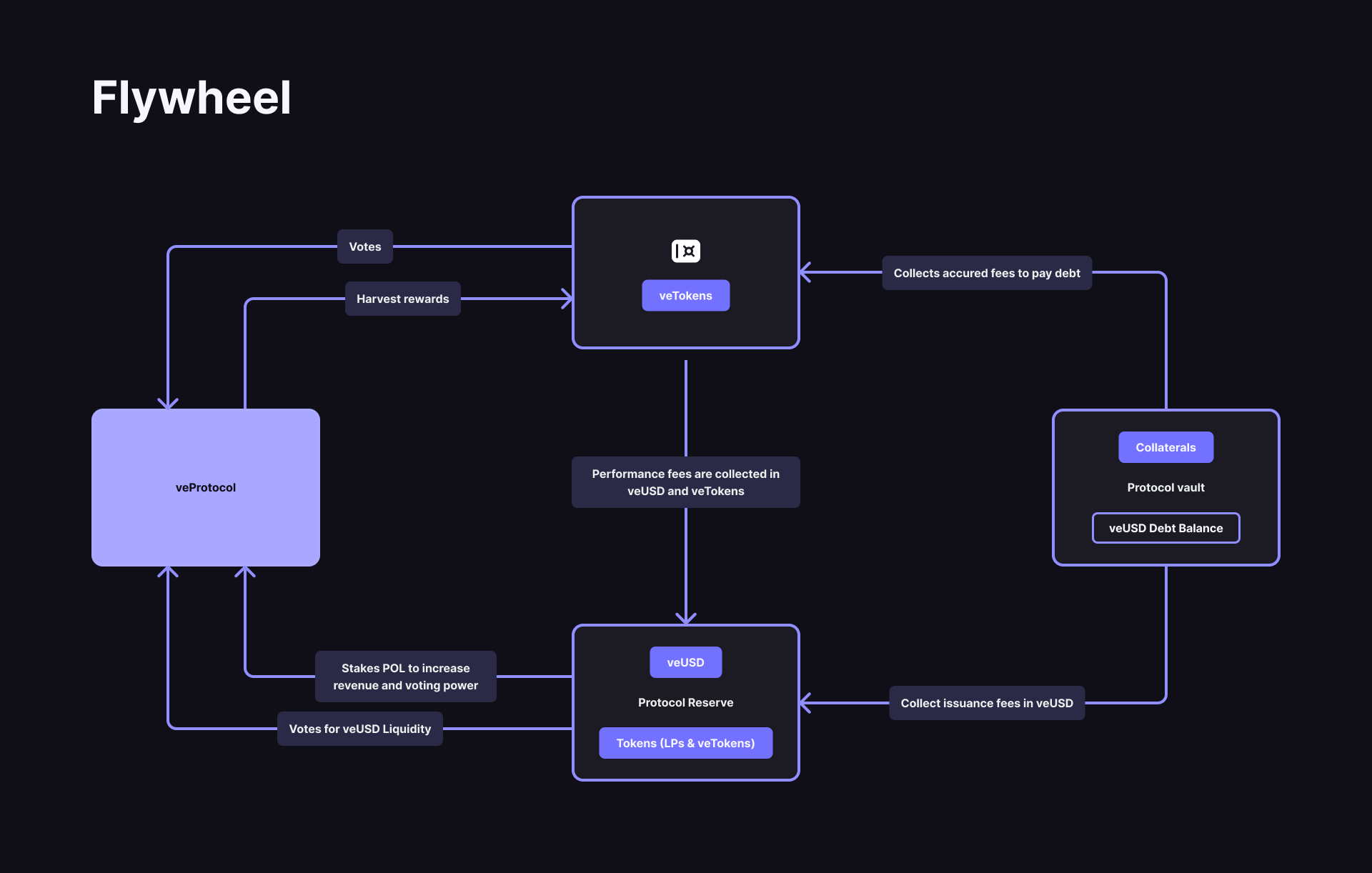
As Vaultedge will count with a big amount of veTokens in the collateral vaults, the protocol will implement strategies that will serve 2 specific functions:
* **Propel USDVE liquidity on Dexes**, to ensure deep liquidity pools by voting toward USDVE pairs. Leveraging on the ve(3,3) Dexes, Vaultedge will drive rewards to USDVE farms.
* **Maximizing rewards harvested by the protocol.** This approach addresses two crucial aspects of Vaultedge, repaying users' debt and growing the Vaultedge treasury. The implemented strategy will have a compounded effect, accelerating debt repayment and increasing protocol revenue through a 15% management fee on the yield.
# Info & Security
# Oracles
Vaultedge uses the [industry standard decentralized oracles Chainlink](https://docs.chain.link/data-feeds) as its primary oracle which provides highly secure and reliable, tamper-resistant data feeds.**Chainlink** oracles are used across the following collaterals:
Asset
Address
USDC/USDT
0x7e860098F58bBFC8648a4311b374B1D669a2bc6B
cbBTC/USDT
0x07DA0E54543a844a80ABE69c8A12F22B3aA59f9D
wETH/USDT
0x71041dddad3595F9CEd3DcCFBe3D1F4b0a16Bb70
weETH/USDT
0xFC1415403EbB0c693f9a7844b92aD2Ff24775C65
wstETH/USDT
0xB88BAc61a4Ca37C43a3725912B1f472c9A5bc061
# Audits
Vaultedge is built upon the **Gravita Protocol** codebase, a well-audited and battle-tested fork of the **Liquity V1 architecture**. Our smart contracts inherit Gravita’s proven framework for collateralized debt positions (CDPs), liquidation logic, and stability mechanisms, ensuring a high level of reliability and security from inception.
Gravita’s contracts have undergone multiple independent audits conducted by **Dedaub**, **Zokyo**, and **Guardian Audits**, covering the core system contracts (BorrowerOperations, TroveManager, StabilityPool, PriceFeed, ActivePool, and associated modules). Since Vaultedge maintains the same foundational smart contract architecture with isolated vault extensions and minor configuration adjustments, these prior audits remain **fully applicable** to our implementation.
#### Smart Contract Auditors
Here are the findings of the audits performed by Gravita Protocol's partners on the code deployed at the addresses in the [Smart Contracts](https://docs.gravitaprotocol.com/gravita-docs/about-gravita-protocol/smart-contracts) section.
Gravita was audited by:
* Dedaub - Here are [their findings](https://www.gravitaprotocol.com/audits/gravita-audit-report-dedaub-apr-23-2023.pdf)
* Omniscia - Here are [their findings](https://www.gravitaprotocol.com/audits/gravita-audit-report-omniscia-may-17-2023.pdf)
* Hats Audit Competiton - at the [end of April](https://twitter.com/HatsFinance/status/1649954788002476034) 2023, [Gravita ](https://twitter.com/gravitaprotocol/status/1649150062860337153)held an Audit Competition with $ 105k USDC in prizes through Hats Finance. No High or Critical findings were exposed, and [all Medium and Low findings were addressed. ](https://hatsfinance.medium.com/gravita-audit-competition-final-writeup-dfb28463a0dc)
# Terms and Conditions
Last Updated: 21/03/2025
These Terms and Conditions (“Terms”) govern your (“User”, “you” or “your”) access to and use of the Vaultedge platform (the “Platform”), including the associated website at (the “Website”). By accessing or using the Platform, you agree to be bound by these Terms, including all notices and disclaimers contained herein. If you do not agree with these Terms, you must immediately cease using the Platform.
1. Acceptance of Terms
By accessing or using the Platform, you confirm that you have read, understood, and agree to be bound by these Terms and any future modifications. Your continued use of the Platform constitutes your acceptance of any changes. It is your responsibility to review these Terms periodically.
Please note that the Privacy Policy, is hereby incorporated by reference into these Terms. By accessing or using the Platform, you acknowledge and agree to be bound by the Privacy Policy as part of these Terms. If you do not agree with the Privacy Policy, please refrain from using the Platform.
2. Definitions
For purposes of these Terms, the following definitions apply:
* Vaultedge: A decentralized borrowing protocol enabling users to borrow against their portfolio of assets by minting USDVE, a USD-pegged, over-collateralized stablecoin.
* USDVE: The USD-pegged stablecoin issued exclusively through the Vaultedge protocol upon the deposit of eligible collateral.
* DAO: Decentralized Autonomous Organization responsible for managing the on-chain aspects of the Vaultedge protocol.
* Front End: The Website and user interface provided by the Company solely for displaying on-chain data and facilitating user interactions with the Protocol.
* User: Any person or entity accessing or using the Platform.
* Restricted Jurisdictions: Jurisdictions prohibited from accessing the Platform, including those designated on the OFAC and FATF lists, or other high-risk/blacklisted regions as determined by applicable law.
* Blacklisted Wallets: digital wallet addresses that, based on internal compliance screening procedures and in accordance with applicable laws and regulatory guidelines, are identified as being associated with users from Restricted Jurisdictions or with entities subject to sanctions or otherwise deemed high-risk. Such wallet addresses are subject to access restrictions that are enforced solely through the Platform’s front-end mechanisms, and the Company reserves the right to modify its criteria for determining Blacklisted Wallets at its sole discretion, without liability for any errors or inaccuracies.
3. Eligibility and User Representations
4. Eligibility: By using the Platform, you represent that you:
5. Are at least 18 years of age (or the applicable legal age in your jurisdiction).
6. Are not subject to economic or trade sanctions administered or enforced by any governmental authority; or otherwise, you are not a member of any sanctions list or equivalent maintained by the United States government, the United Kingdom government, the European Union, or the United Nations, including without limitation the U.S. Office of Foreign Asset Control Specifically Designated Nationals and Blocked Person List.
7. Possess the legal capacity to enter into these Terms.
3.2 User Self-Certification: Before accessing the Platform, you must complete a transaction-based self-certification confirming that you are not a U.S. citizen or resident and do not originate from any Restricted Jurisdiction. Any false or misleading information provided during self-certification may result in immediate termination of access.
4. Access Restrictions and Geo-Blocking
1. Geo-Blocking: The Platform shall implement geo-blocking mechanisms on its Front End to restrict access by users located in, or attempting to access the Platform from, any jurisdiction designated as a "Restricted Jurisdiction" (as defined in the Definitions section of these Terms). Such measures may include, but are not limited to, IP address filtering, location-based redirection, and requiring users to confirm their country of residence. The list of Restricted Jurisdictions may be updated by the Company at its sole discretion and without prior notice. By accessing the Platform, users acknowledge and consent to the application of these geo-blocking measures.
2. Jurisdictional Access Restrictions: In order to comply with applicable international and domestic regulations—including those enforced by the Office of Foreign Assets Control (OFAC) and the Financial Action Task Force (FATF)—the Platform will restrict access to users from jurisdictions subject to sanctions, embargos, or identified as high-risk. Users determined to be originating from or currently located in such jurisdictions shall be prevented from accessing, registering on, or transacting through the Platform. The Company shall continuously monitor regulatory updates and modify the list of restricted jurisdictions accordingly. These restrictions shall apply irrespective of the method or device used to access the Platform.
3. Blocking of Blacklisted Wallets: To ensure regulatory compliance while maintaining the decentralized operation of on-chain activities, the Platform shall enforce the blocking of digital wallet addresses ("Blacklisted Wallets") identified through internal compliance screening procedures and third-party verification as being associated with users from Restricted Jurisdictions or with sanctioned/high-risk entities. Identification methods may include analysis of user self-certification data, blockchain analytics, and other compliance tools. Blocking of such wallets shall be executed solely at the Front End level, ensuring that while these wallets are restricted from accessing the Platform’s services, the underlying decentralized protocol remains unaffected. The Company reserves the right to update its criteria and mechanisms for identifying Blacklisted Wallets at its sole discretion and shall not be held liable for any misclassification or errors arising from these determinations.
5. Platform Operation and Scope
1. Front End Responsibility: The Company is responsible solely for the development, operation, and maintenance of the Platform’s Front End. The Website collects and displays only on-chain data and does not interact directly with user funds.
2. On-Chain Operations: The on-chain functions of the Vaultedge protocol are governed and executed by the DAO. The Company is not responsible for the on-chain operations, including smart contract execution, governance, or protocol upgrades.
3. Protocol Description: Vaultedge enables Users to deposit eligible collateral to mint USDVE, a USD-pegged stablecoin that is over-collateralized. Eligible collateral includes, but is not limited to:
* Blue-chip Assets: Well-established cryptocurrencies and stablecoins (e.g., WETH, WBTC, USDC, USDT, LYNX).
* Staked Assets: Assets derived from staking, such as wrapped staked ETH (wsETH).
* Liquidity Provider (LP) Tokens: Tokens representing stakes in decentralized liquidity pools.
* Voting Escrow (VE) Tokens: Tokens used in governance mechanisms.
* Real World Assets (RWAs): Selected traditional assets as approved under the protocol’s guidelines.
By depositing eligible collateral, Users can mint USDVE according to the platform’s dynamically determined collateralization requirements, ensuring that the value of the deposited collateral exceeds the value of the minted USDVE. This over-collateralization mechanism is designed to mitigate the risks associated with market volatility.
A detailed list of services and functionality of the Platform shall be made available to Users on the relevant page of the Website. The Company reserves the right to change the information on the list of services and functionality of the Platform at any time if the relevant functionality and services are changed by the DAO decision. The Company is not responsible for when and how DAO changes the functionality and services of the Platform.
4. Smart contracts: By using the Platform, you acknowledge and agree that all transactions executed on blockchain-based networks are automatically processed by one or more smart contracts. You hereby consent to such automated execution and processing of transactions in connection with your use of the Platform. Furthermore, you acknowledge and agree that the terms encoded within the applicable smart contract(s) shall govern the allocation of funds and the transfer of ownership of any cryptoassets involved in each transaction.
5. User Control Over Cryptoassets: Users retain full control over their cryptoassets at all times. Neither we nor any affiliated entity is a party to any transaction executed on the blockchain networks underlying Platform. We do not possess, control, or have custody of any cryptoassets or user funds. When you interact with Platform, you maintain sole control over your cryptoassets.
6. Use of Third-Party Self-Custodial Wallets: Access to Platform may require the use of third-party self-custodial wallets. We do not control, guarantee, or assume responsibility for the performance, security, or reliability of these wallets. By using the Front End to access Platform, you acknowledge that your self-custodial wallet is provided and maintained by a third-party service provider and is subject to its separate terms, conditions, fees, disclaimers, and risk warnings. It is your sole responsibility to review and understand those terms to ensure compliance and awareness of any associated costs or risks.
7. Non-Intermediary Status: Due to the decentralized and non-custodial nature of Vaultedge, we act solely as the provider of the Platform’s Front End interface and are not an intermediary, agent, advisor, or custodian with respect to any Vaultedge transactions. We do not have any fiduciary obligations to you regarding your transactions or any activities you conduct using our Platform.
8. Limited Access to Transactional Information: We do not have access to information about all Vaultedge transactions beyond what is publicly available on the blockchain. However, we may collect information regarding users of our Platform in accordance with our Privacy Policy.
9. Blockchain Fees: Transactions on blockchain networks may incur gas fees or other network transaction fees, which are non-refundable. We do not provide services related to the delivery, holding, or receipt of cryptoassets, nor do we collect any fees from such transactions.
10. Prohibited activity of Platform or Website: You are expressly prohibited from engaging in any of the following activities:
11. Unlawful Activities – Using the Website or Platform for any illegal purpose or in furtherance of any unlawful activity, including but not limited to money laundering, terrorist financing, tax evasion, or the purchase, sale, or distribution of illegal drugs, contraband, counterfeit goods, or prohibited weapons.
12. Unauthorized Commercial Use – Exploiting the Website or Platform for any unauthorized or unapproved commercial purpose, including any fraudulent activities.
13. Malicious Code – Uploading, transmitting, or distributing viruses, worms, Trojan horses, time bombs, cancel bots, spiders, malware, or any other harmful software or code that could disrupt, compromise, or interfere with the proper functioning of the Website or Platform.
14. Unauthorized Access and Reverse Engineering – Attempting to copy, modify, decompile, disassemble, reverse engineer, or otherwise extract source code or underlying ideas from any parts of Website or Platform\`s functionality, including by reformatting or framing content, without prior written consent.
15. Unauthorized Data Collection – Harvesting, scraping, or otherwise collecting data or information from the Website or Platform without express authorization.
16. Fraud and Deception – Accessing or using the Website of Platform under false or fraudulent pretenses, engaging in any misleading or deceptive conduct, or misrepresenting your identity or affiliations.
17. Interference with Other Users – Disrupting, interfering with, or otherwise preventing other Users from accessing or lawfully using the Website or Platform.
18. Circumvention of Security Measures – Tampering with, bypassing, or interfering with security features, access controls, or other protective measures of the Website or Platform, any third-party systems, or networks used in connection with the Website or Platform.
19. Exploitation of Smart Contracts – Engaging in hacking, denial-of-service attacks, or any exploitative action on smart contracts in connection with the Website or Platform, even if such actions are technically possible within the smart contract’s code.
20. Anticompetitive Behavior – Engaging in any conduct that constitutes unfair competition, market manipulation, or any other deceptive, abusive, or unethical business practice.
11. Consequences of prohibited activity: Company reserves the right, at our sole discretion, to:
* Restrict, suspend, or permanently revoke your access to Website or Platform, in whole or in part, if you violate these Terms, applicable law, or engage in any prohibited activity.
* Take corrective actions, including modifying, rectifying, or altering transaction data to mitigate harm caused by a violation of these Terms or applicable law.
* Investigate and prosecute any suspected breach of these Terms, including cooperating with law enforcement bodies and regulatory authorities, and disclosing relevant information as necessary to comply with legal obligations.
Violations of these Terms may result in civil, criminal, or administrative liability, and we reserve all legal rights and remedies available under applicable law.
12. Compliance with Laws: You shall comply with all applicable laws, regulations, and guidelines in connection with your use of the Platform. Failure to comply may result in suspension or termination of access.
6. Intellectual Property and Content
1. Company\`s ownership. The Website, including any models, interfaces, algorithms, indexes or other software developed by Company or its affiliates, contractor, employees or subsidiaries, along with all associated features, functionality, and tools, is protected by copyright, trademark, patent, trade secret, and other intellectual property local and international laws. You acknowledge and agree that the Platform and all related intellectual property rights are our exclusive property and our licensors. You are prohibited from removing, altering, or obscuring any copyright, trademark, service mark, patent marking, or other proprietary rights notices incorporated in or accompanying the Platform.
2. Trademarks. The company name, the term "Vaultedge" the company logo, and all related names, logos, product and service names, designs, and slogans are trademarks of the Company or its affiliates or licensors. You must not use such marks without the prior written permission of Company. All other names, logos, product and service names, designs, and slogans on the Platform are the trademarks of their respective owners.
3. User Content: Any data or content you provide in connection with the Platform shall be subject to the Company’s Privacy Policy. The Company reserves the right to remove or block any content that violates these Terms or applicable laws.
4. License: Subject to your continued compliance with these Terms, we grant you a personal, worldwide, revocable, non-exclusive, and non-transferable license to access and use the Platform. This license is granted solely for the purpose of enabling you to use the Platform in accordance with these Terms.
5. Feedback: Any feedback, suggestions, ideas, bug reports, or other information you provide regarding Platform or Website, whether solicited or unsolicited, is entirely voluntary. By submitting such feedback, you grant us a perpetual, irrevocable, worldwide, royalty-free, and transferable right to use, modify, distribute, and otherwise exploit the feedback in any manner, including sharing it with third parties, without any obligation to provide compensation, attribution, or any other benefit to you. You further acknowledge that we have no obligation to implement, consider, or maintain the confidentiality of any feedback provided.
7. Taxes
1. Taxation responsibility: Users are solely responsible for determining, reporting, and paying any taxes, duties, or assessments that may be imposed by any governmental authority in connection with their use of the Platform. This includes any liabilities arising from the use, transfer, or exploitation of cryptoassets and interactions with smart contracts. Users acknowledge that blockchain-based transactions are novel, and their tax treatment remains uncertain. It is the User's responsibility to seek independent tax advice to ensure compliance with applicable laws.
8. Risk Disclosures and Legal Disclaimers
1. Risk Acknowledgment: Users acknowledge that all on-chain interactions with the Vaultedge protocol, including collateral deposits, USDVE minting, and related transactions, are subject to inherent risks typical of decentralized systems. These risks include, but are not limited to:
* Technical Risks: Smart contract vulnerabilities, coding errors, and network congestion.
* Market Risks: Price volatility of collateral assets that may trigger automated liquidation if collateral values fall below required thresholds.
* Operational Risks: Potential delays or failures in transaction processing and protocol operations.
* Regulatory Risks: Uncertainties arising from the evolving regulatory landscape affecting decentralized protocols.
Users are solely responsible for understanding and managing these risks. It is recommended that users perform their own due diligence and seek independent financial and technical advice before engaging with the Vaultedge protocol. The Company, its affiliates, and the DAO shall not be held liable for any losses or damages incurred as a result of these inherent risks.
2. No Financial, Investment, or Legal Advice: The information provided on the Platform is for informational purposes only and does not constitute financial, investment, or legal advice. You should consult with professional advisors before engaging in any transactions.
3. Service “As-Is” Basis: The Platform is provided “as-is” and “as available” without any warranties, express or implied. The Company expressly disclaims all warranties, including but not limited to those of merchantability, fitness for a particular purpose, and non-infringement.
4. No Custodial Relationship: The Company does not custody or control user funds. All on-chain interactions are executed directly through smart contracts managed by the DAO, and you remain solely responsible for managing your digital assets.
9. Limitation of Liability
1. Disclaimer of Warranties: The Company makes no representations or warranties regarding the performance, reliability, or availability of the Platform. Use of the Platform is at your own risk.
2. Limitation of Liability: To the fullest extent permitted by applicable law, Company, its directors, officers, contractors, employees, affiliates or subsidiaries shall be liable to you for any loss, damage, or injury of any kind, including but not limited to direct, indirect, incidental, special, exemplary, consequential, or punitive damages, or for any loss of profits, data, use, business, goodwill, or any other intangible losses, whether arising in contract, tort (including negligence), indemnity, strict liability, statute, or otherwise, even if advised of the possibility of such damages. Without limiting the foregoing, such exclusion of liability applies to any damages arising out of or in connection with:
* the use of Platform or your inability to use or access the Platform;
* any misuse of the Platform, including without limitation, unauthorized access;
* any conduct by Users on the Platform;
* the termination, suspension, or restriction of your access to the Platform.
Furthermore, Company, its directors, officers, contractors, employees, affiliates or subsidiaries shall not be liable for any damages, in whole or in part, caused by or arising from:
* user errors, including but not limited to forgotten passwords or incorrectly constructed smart contracts or transactions;
* server failures or data loss;
* malfunctions, unintended functionalities, or unexpected behaviors of the blockchain, any computer or crypto asset network (including wallet providers), including losses associated with network forks, replay attacks, double-spend attacks, governance disputes, variations in mining difficulty, changes in cryptographic or consensus mechanisms, hacking, or cybersecurity breaches;
* changes in the value of any cryptoasset;
* changes in law, regulation, or policy;
* events of force majeure;
* or actions of any third party.
In no event shall the aggregate liability of Company, its directors, officers, contractors, employees, affiliates or subsidiaries to you or any other user, from any and all claims and causes of action, exceed one thousand U.S. dollars.
Under no circumstances shall Company, its directors, officers, contractors, employees, affiliates or subsidiaries be required to provide you with any virtual currency as a remedy, to order specific performance, or to provide any other remedy. If damages are calculated in relation to the value of a virtual currency, both you and we agree that such calculation shall be based on the lowest value of the virtual currency during the period between the accrual of the claim and the determination of damages.
Some jurisdictions do not allow the exclusion or limitation of certain warranties or liabilities. Accordingly, in those jurisdictions, the limitations and exclusions set forth herein may not apply to you to the fullest extent permitted by law, and the liability of Company, its directors, officers, contractors, employees, affiliates or subsidiaries and the scope of any warranties will be limited to the maximum extent permitted by applicable law.
3. Force Majeure: Neither party shall be liable for any failure or delay in performing its obligations under these Terms if such failure or delay is due to events beyond its reasonable control, including, but not limited to, natural disasters, acts of government, labor disputes, or other force majeure events.
10. Indemnification
1. General indemnification: You agree to indemnify, defend, and hold harmless the Company, our affiliates, directors, officers, employees, contractors and subsidiaries from and against any and all claims, liabilities, damages, losses, costs, and expenses, including reasonable attorneys' fees, arising out of or related to:
* Breach of Terms: Your actual or alleged breach of these Terms.
* Misuse of Platform: Your improper or unauthorized use of the Platform, or any related smart contracts or scripts.
* Legal Violations: Your violation of any applicable laws, regulations, rules, codes, statutes, ordinances, or orders issued by governmental or quasi-governmental authorities.
* Third-Party Rights: Your infringement or alleged infringement of any third party's rights, including intellectual property, publicity, confidentiality, property, or privacy rights.
* Third-Party Services: Your use of any third-party products, services, or websites in connection with the Platform.
* Misrepresentations: Any false, misleading, or inaccurate representations made by you.
2. Indemnification cooperation: We reserve the right, at your expense, to assume the exclusive defense and control of any matter subject to indemnification by you. You agree to cooperate fully with us in asserting any available defenses. You shall not settle any claim without our prior written consent.
11. Modifications to the Platform and Terms
1. Modifications to Platform: The Company reserves the right to modify, suspend, or discontinue the Platform or any part thereof at any time without prior notice. Changes to on-chain operations, including smart contract updates, are governed by the DAO.
2. Amendments to Terms: The Company may amend these Terms at any time. Any changes will be effective immediately upon posting on the Website. Your continued use of the Platform constitutes acceptance of the updated Terms.
12. Termination and Suspension
1. Termination: The Company may terminate or suspend your access to the Platform at any time, with or without cause, and without prior notice, in its sole discretion.
2. Effect of Termination: Upon termination, all rights granted to you under these Terms will immediately cease, and you must promptly discontinue your use of the Platform.
13. Governing Law and Dispute Resolution
1. Governing Law: These Terms shall be governed by and construed in accordance with the laws of Marshall Islands, without regard to any conflict of laws principles.
2. Negotiations: Prior to initiating any legal proceedings, including arbitration as outlined below, both parties agree to engage in good faith negotiations to resolve any dispute, claim, or controversy arising out of or relating to these Terms or use of Platform (each, a "Dispute" and collectively, "Disputes"). The aggrieved party shall provide written notice to the other party detailing the nature of the Dispute. The receiving party shall have thirty (30) business days to respond. Within sixty (60) business days of the initial notice, both parties shall confer in good faith to attempt to resolve the Dispute. If unresolved within ninety (90) business days of the initial notice, the parties may agree to mediation or proceed to arbitration as specified below.
3. Arbitration: Any dispute, controversy or claim arising out of or relating to these Terms, or the breach, termination or invalidity thereof, shall be settled by arbitration administered under the laws of the Marshall Islands, with proceedings conducted in accordance with the applicable arbitration rules of the Marshall Islands. The arbitrator(s) shall possess expertise in matters involving internet technology, software applications, financial transactions, and, preferably, blockchain technology. The prevailing party shall be entitled to reasonable attorney's fees and costs. Except as required by law, neither party nor its representatives may disclose the existence, content, or results of any arbitration without prior written consent from the other party.
4. Class Action Waiver: You agree that any claims, disputes, or controversies arising out of or relating to these Terms or your use of the Platform shall be resolved solely on an individual basis. You expressly waive your right to participate in any class, collective, or representative action or proceeding against us, whether in arbitration or litigation. Any dispute resolution process, including arbitration, shall be conducted only on an individual basis, and no arbitrator or court shall have the authority to consolidate or join claims of multiple users. If any portion of this class action waiver is held to be invalid or unenforceable under applicable law, then such provision shall be severed, and the remainder of these Terms shall continue in full force and effect, with all disputes to be resolved individually.
\
14. Entire Agreement and Severability
1. Entire Agreement: These Terms, together with our Privacy Policy and any additional policies referenced herein, constitute the entire agreement between you and the Company regarding your use of the Platform and supersede all prior or contemporaneous understandings or agreements.
2. Severability: If any provision of these Terms is found to be invalid or unenforceable, the remaining provisions shall remain in full force and effect, and the invalid or unenforceable provision shall be replaced by a valid provision that most closely reflects the parties' original intent.
15. Contact Information
If you have any questions, concerns, or comments regarding these Terms, please contact us at:
Email: \
This document constitutes a legally binding agreement between you and the Company regarding your use of the Vaultedge Platform. By using the Platform, you acknowledge that you have read, understood, and agreed to these Terms and Conditions.
# Privacy Policy
This Privacy Policy explains how Vaultedge (“Vaultedge”, “we”, “us”, “our”) collects, uses, discloses, stores and protects personal and device-related information when you access or use our website, applications, and services (the “Services”). By using the Services you agree to the terms of this Privacy Policy.
#### 1 Types of information we collect
* Account information: email address, display name, profile data you provide when you sign up or opt in to features.
* On‑chain information: public blockchain addresses and on‑chain transaction data that you choose to link to your Vaultedge account (balances, tokens used as collateral, borrowing and staking activity).
* Device and usage data: device type, operating system, IP address, browser/user agent, referral data, page views, feature usage, crash logs, and analytics events.
* Support and communications: copies and metadata of messages you send to support, community channels, or other Vaultedge communication channels.
* Optional verification data: information you provide to third‑party identity verification (KYC/AML) providers when you elect to complete verification; such third parties control their own processing practices.
* Aggregated and anonymized data: non‑identifying statistics derived from user data for analytics and product improvement.
#### 2 How we use information
We use data to:
* Provide, operate and maintain the Services, including features such as collateral management, zero‑interest borrowing, USDVE borrowing and staking, strategy views, and any other product functionality.
* Execute on‑chain operations you authorize and display your positions, balances and transaction history.
* Improve and personalize the Services through analytics and product development.
* Communicate about your account, transactions, security alerts, product updates and, where you consent, marketing or promotional messages.
* Detect, investigate and prevent fraud, abuse or other unlawful activity and enforce our Terms of Use.
* Comply with legal obligations or respond to lawful requests by public authorities.
#### 3 Legal bases for processing
Where applicable, our legal bases include:
* Consent for optional processing you explicitly agree to (marketing, analytics opt‑ins).
* Contract performance when processing is necessary to deliver the Services or to execute transactions you request.
* Legal obligation to comply with laws, regulations, or legal process.
* Legitimate interests for fraud prevention, security, service operation and product improvement, provided such interests do not override your fundamental privacy rights.
#### 4 Sharing and disclosure
We may share information as follows:
* Service providers and partners: third‑party vendors who perform services on our behalf (hosting, analytics, KYC/AML, customer support). They are contractually limited to using data only to provide those services.
* Blockchain networks: on‑chain addresses and transactions are public by nature; Vaultedge cannot make public ledger data private.
* Legal and safety: when required to comply with law, legal process, or to protect the rights, property or safety of Vaultedge, our users, or others.
* Business transfers: in connection with a merger, acquisition, sale, reorganization or bankruptcy, user data may be transferred as an asset subject to confidentiality and applicable law.
* Aggregated data: we may publish anonymized or aggregated statistics that do not identify individuals.
#### 5 Security measures and user responsibilities
* We maintain administrative, technical and physical safeguards designed to protect data from unauthorized access, disclosure or destruction, including encryption, secure development practices and access controls.
* You are responsible for securely storing your private keys, Secret Recovery Phrase and other credentials. Vaultedge will never ask you to disclose your Secret Recovery Phrase.
* No system is perfectly secure. In the event of a security incident affecting personal data, we will follow applicable disclosure and notification obligations.
#### 6 Data retention and deletion
* We retain account and transactional data as long as necessary to provide Services, comply with legal obligations, resolve disputes, enforce agreements and meet legitimate business needs.
* You may request deletion of personal account data to the extent permitted by law and practicable. Public on‑chain records and immutable ledger data cannot be deleted.
#### 7 Cookies and tracking technologies
* We and our third‑party partners use cookies, local storage, SDKs and similar technologies to collect device and usage information.
* You can control cookie settings through your browser or device; disabling certain cookies may affect functionality.
#### 8 Your rights and choices
Subject to local law, you may have rights to:
* Access and correct personal data we maintain about you.
* Request deletion of personal data where lawful and feasible (excluding on‑chain data).
* Opt out of marketing communications and certain analytics tracking. To exercise rights, contact us at the address below. We will respond within applicable legal timeframes.
#### 9 Minors
Our Services are not intended for individuals under 18 or the legal age of your country of residence. We do not knowingly collect personal data from minors. If we become aware we have collected data from a minor, we will take steps to delete it.
#### 10 Third‑party links and services
The Services may include links, integrations or connectors to third‑party sites and services (exchanges, DEXs, bridges, wallets, analytics and KYC providers). We are not responsible for their privacy practices. Review their privacy policies before sharing personal data with them.
#### 11 International transfers
We operate globally and may transfer, store or process data outside your jurisdiction. When we do, we apply contractual safeguards and other lawful mechanisms to protect your data.
#### 12 Changes to this Privacy Policy
We may update this Privacy Policy to reflect changes in our practices or legal requirements. We will publish a revised policy with an updated “Last updated” date and notify users of material changes where appropriate.
#### 13 Limitation of liability
* No fiduciary relationship Nothing in this Privacy Policy creates a fiduciary duty or special relationship between Vaultedge and you.
* Use at your own risk You use Vaultedge and the Services at your own risk. Vaultedge provides tools to interact with public blockchains and financial primitives; we do not control blockchains, token contracts or third‑party platforms.
* No guarantee of availability or results Vaultedge does not guarantee uninterrupted access to the Services, the accuracy or completeness of on‑chain or off‑chain data, or specific outcomes from using the Services.
* Indirect and consequential damages excluded To the fullest extent permitted by applicable law, Vaultedge, its affiliates, officers, directors, employees and service providers will not be liable for any indirect, incidental, special, consequential or exemplary damages (including loss of profits, loss of data, loss of goodwill or lost savings), even if advised of the possibility of such damages.
* Cap on direct damages Where liability cannot be excluded under applicable law, Vaultedge’s aggregate liability for direct damages arising out of or related to your use of the Services will be limited to the amount you paid Vaultedge in the 12 months preceding the claim, or USD 100 (or equivalent) if you did not pay Vaultedge in that period, whichever is greater.
* Security and user responsibility You acknowledge that you are responsible for securing your own keys, devices and credentials; Vaultedge is not liable for losses resulting from compromise, loss or theft of your private keys, Secret Recovery Phrase or credentials.
* Third‑party providers Vaultedge is not liable for actions or omissions of third‑party services integrated with our platform (exchanges, KYC providers, wallets, bridges).
* Regulatory and legal limits Nothing in this section is intended to limit liability that cannot be limited under applicable law.
#### 14 Contact
Questions, requests or privacy concerns may be directed to:
Vaultedge is committed to protecting personal data while enabling secure interaction with on‑chain financial products. Please keep your Secret Recovery Phrase and private keys secure and contact us if you have privacy questions.
\
# Pareto Points & Referral Campaign
## Pareto Points & Referral Program
Pareto Points (PP) reward users who contribute capital, take on debt, and actively deploy USDVE within the ecosystem. The system prioritizes debt creation and active USDVE deployment over passive holding.
{% hint style="info" %}
Pareto points are updated once per day
{% endhint %}
***
### Getting Access
Connect your wallet and complete your first onchain interaction to become an **active user**. This unlocks point earning and your referral link.
**Qualifying first interactions:**
* Depositing collateral and minting USDVE
* Depositing into the Stability Pool
***
### Staying Active
Active status requires at least one contract interaction per month. Going a full calendar month without interacting removes your active status until you interact again. Inactive users are excluded from the median calculation and lose airdrop eligibility.
**Interactions that count toward staying active:**
* Depositing or withdrawing collateral
* Borrowing or repaying USDVE
* Adding or removing LP
* Staking or unstaking in the Stability Pool
***
### Airdrop Eligibility: The Median Threshold
To qualify for the airdrop, your PP total must be **above the median** of all active users at the time of the final snapshot. Below the median means zero airdrop.
**How the median is calculated:**
All active users are ranked by total PP. The median is the PP value of the user at the 50th percentile. For example, with 1,000 active users, the median equals the PP of user #500 when sorted by points. The median updates daily so you can track your standing in real time, but the final snapshot at the end of the campaign is what determines actual eligibility.
The median is a moving target. As others earn more, you need to keep pace. Early users have an advantage, but cannot coast.
**What you'll see in the app:**
* Your current PP total
* If you are above or below the median
* Your rank among active users
***
### Earning Points
#### Core Actions
| Action | Points | Type | Notes |
| -------------------------------- | --------------------------- | ---------- | ---------------------------------------- |
| Hold sUSDVE | 6 PP per $1 per day | Time-based | New. Highest rate in the program |
| Deposit collateral | 0.25 PP per $1 per day | Time-based | While collateral remains |
| Borrow USDVE | 2 PP per $1 of debt per day | Time-based | Rewards maintaining debt, not opening it |
| Provide USDVE liquidity (Hydrex) | 0.75 PP per $1 per day | Time-based | USDVE/USDC pool |
Stability Pool staking is being retired in favor of sUSDVE. Existing staker have a migration window to move their position.
#### Collateral Multipliers
Different collateral types earn bonus PP on deposits.
| Collateral | Multiplier |
| ----------------- | ---------- |
| cbBTC | TBD |
| wstETH | TBD |
| weETH | TBD |
| Morpho wETH | TBD |
| Morpho USDC Prime | TBD |
#### Debt Multipliers (Borrowing Points Only)
| Condition | Multiplier |
| ---------------------- | ---------- |
| Borrow from 1 market | 1.0x |
| Borrow from 2 markets | 1.5x |
| Borrow from 3+ markets | 2.0x |
#### Social Actions
| Action | Points | Type |
| ------------- | ------ | -------- |
| Join Discord | 5 PP | One-time |
| Join Telegram | 5 PP | One-time |
***
### Referral System
Once active, you have a **permanent referral link** with unlimited uses. Find it under the **Referrals** tab in the app.
A referral is credited once the person you referred starts earning points, meaning they deposit, borrow, or provide liquidity. Connecting a wallet alone doesn't trigger it.
**Referral rewards:** You earn **20% of all PP** your referrals earn, forever. Referrals keep 100% of their own points, your bonus is additive, not taken from them. Your referral earnings are capped at your own activity level, so keep a position open to earn the full amount.
***
### Protocol Milestones
When the protocol hits collective goals, one-time shared rewards unlock for all active users. You must be active at the time a milestone is reached to qualify.
| Milestone | Reward |
| ------------------ | --------------------------------------------- |
| $5M TVL | All active users: +1,000 PP |
| $15M TVL | All active users: +5% multiplier for 14 days |
| $30M TVL | All active users: +5,000 PP + exclusive badge |
| 10M USDVE minted | All borrowers: +5% multiplier for 14 days |
| 1,000 active users | Everyone: +2,500 PP |
***
### Tier System
Tiers unlock badge categories and provide visual progression, displayed next to your PP balance.
| Tier | PP Threshold | Badge Access | Visual |
| ------ | ------------ | ---------------------- | ------------------------------ |
| Green | 0 | Onboarding only | Circle, flat finish |
| Bronze | 100,000 | + Base Ecosystem | Hexagon, matte finish |
| Silver | 1,000,000 | + Pareto Zone & Health | Octagon, polished, subtle glow |
| Gold | 5,000,000 | All badges | Dodecagon, radiant, animated |
***
### Badge Multiplier System
Badges provide additive bonuses to your base PP earning rate. Multipliers stack, with a maximum combined bonus of **+75%**.
Multipliers are additive, not multiplicative. If you hold Pareto Master (+15%) and Influence Circle (+10%), your total bonus is +25%, turning a base daily rate of 100,000 PP into 125,000 PP. Each multiplier has a duration and requires you to maintain criteria. Falling below the criteria pauses the multiplier until you qualify again.
#### 1. Onboarding Badges (All Tiers)
| Badge | Criteria | Hold Period | Reward |
| --------------- | ------------------- | ----------- | --------- |
| Funded & Ready | Deposit $220+ | 3 days | +500 PP |
| First Mover | Borrow 1,000+ USDVE | 7 days | +2,500 PP |
| Committed Edger | Borrow 5,000+ USDVE | 7 days | +5,000 PP |
| Whale Watcher | Deposit $30,000+ | 14 days | +7,500 PP |
#### 2. Debt Growth Badges (All Tiers)
| Badge | Criteria | Hold Period | Reward |
| ------------- | -------------------------------------- | ----------- | ------------------------- |
| Debt Builder | Maintain 5,000+ USDVE debt | 14 days | +10,000 PP |
| Leverage Lord | Maintain 25,000+ USDVE debt | 30 days | +30,000 PP |
| Credit King | Maintain 50,000+ USDVE debt | 30 days | +75,000 PP |
| Debt Maxi | Increase debt by 25%+ month-over-month | 30 days | +15% multiplier (60 days) |
#### 3. Full Loop Badges (All Tiers)
Rewards users who complete the optimal protocol loop: Deposit → Borrow → Deploy USDVE.
| Badge | Criteria | Hold Period | Reward |
| ------------- | ------------------------------------------------------------- | ----------- | ------------------------------------- |
| Loop Initiate | Deposit $1k+ AND borrow 500+ USDVE AND LP 500+ on Hydrex | 7 days | +5,000 PP |
| Loop Master | Deposit $10k+ AND borrow 5k+ USDVE AND LP 5k+ on Hydrex | 14 days | +20,000 PP + 10% multiplier (60 days) |
| Full Stack | Deposit $25k+ AND borrow 12.5k+ USDVE AND LP 12.5k+ on Hydrex | 30 days | +50,000 PP + 20% multiplier (90 days) |
#### 4. Pareto Zone & Health Badges (Silver+ Tier)
| Badge | Criteria | Hold Period | Reward |
| ----------------- | ----------------------------------------- | ----------- | ------------------------- |
| Zone Keeper | Maintain Health Factor 1.5-2.0 | 7 days | +7,5000 PP |
| Pareto Master | Maintain Health Factor 1.5-2.0 | 30 days | +15% multiplier (90 days) |
| Capital Efficient | Maintain HF 1.05-1.1 on stablecoin vaults | 14 days | +20% multiplier (60 days) |
#### 5. Activity & Retention Badges (All Tiers)
| Badge | Criteria | Reward |
| ------------------- | ----------------------------------------------- | ------------------------------------- |
| Marginal Gains | Active vault 30 days with 10k+ USDVE debt | +10,000 PP |
| Compound Efficiency | Active vault 60 days with 10k+ USDVE debt | +20,000 PP |
| Efficient Frontier | 3+ vaults for 30 days with 10k+ USDVE debt each | +25,000 PP |
| Diamond Hands | Active vault 90 days with 25k+ USDVE debt | +50,000 PP + 10% multiplier (90 days) |
#### 6. Community & Referral Badges (All Tiers)
| Badge | Criteria | Reward |
| ---------------- | ------------------------------------------ | ------------------------- |
| Influence Circle | Refer 10 active users who borrow 5k+ USDVE | +10% multiplier (60 days) |
| Ambassador | Complete ambassador program | +20% multiplier (90 days) |
#### 7. Base Ecosystem Badges (Bronze+ Tier)
| Badge | Criteria | Hold Period | Reward |
| ----------- | --------------------------------------- | ----------- | --------- |
| Base Native | Hold a Basename | - | +1,000 PP |
| Hydrex Ally | Provide $1,000+ LP on Hydrex USDVE/USDC | 7 days | +4,000 PP |
| Base Maxi | Connect with Coinbase Smart Wallet | - | +2,500 PP |
| Based | Use Vaultedge via the Base app | - | +5,000 PP |
***
### Earning Examples
#### Example 1: Basic User (30 days)
Deposits $10,000 collateral, borrows 5,000 USDVE, LPs all 5,000 USDVE on Hydrex.
| Source | Calculation | PP |
| --------------------- | ------------------------ | -------------- |
| Deposit | $10,000 x 1 PP x 30 days | 300,000 |
| Borrow (one-time) | 5,000 x 20 PP | 100,000 |
| Hydrex LP | 5,000 x 2,5 PP x 30 days | 375,000 |
| First Mover badge | - | 2,500 |
| Committed Edger badge | - | 5,000 |
| Debt Builder badge | - | 10,000 |
| **Total** | | **792,500 PP** |
Tier reached: **Silver** (\~30 days)
#### Example 2: Full Loop User (30 days)
Deposits $30,000 collateral, borrows 15,000 USDVE, LPs 15,000 USDVE on Hydrex. Qualifies for Loop Master badge.
| Source | Calculation | PP |
| ------------------------------------------- | ------------------------- | ------------------ |
| Deposit | $30,000 x 1 PP x 30 days | 900,000 |
| Borrow (one-time) | 15,000 x 20 PP | 300,000 |
| Hydrex LP | 15,000 x 2,5 PP x 30 days | 1,125,000 |
| Loop Master badge | - | 20,000 |
| Loop Master multiplier (+10% on days 15-30) | 10% x \~1,012,500 | 101,250 |
| Debt Builder badge | - | 10,000 |
| **Total** | | **\~2,456,250 PP** |
Tier reached: **Silver** (\~12 days)
#### Example 3: Power User with Multipliers (60 days)
Deposits $100,000 collateral, borrows 50,000 USDVE, LPs 50,000 USDVE on Hydrex. Earns Full Stack (+20%) and Pareto Master (+15%).
| Source | Calculation | PP |
| -------------------------------------------------- | ------------------------- | ------------------- |
| Deposit | $100,000 x 1 PP x 60 days | 6,000,000 |
| Borrow (one-time) | 50,000 x 20 PP | 1,000,000 |
| Hydrex LP | 50,000 x 2,5 PP x 60 days | 7,500,000 |
| Multiplier bonus (+35% on time-based, avg 45 days) | 35% x \~10,125,000 | 3,543,750 |
| Badges (various) | - | \~200,000 |
| **Total** | | **\~18,243,750 PP** |
Tier reached: **Gold** (\~17 days)
#### Example 4: Referral Earnings
You refer a user who earns 7,925,000 PP (Example 1). Your referral bonus: 20% x 792,500 = **158,500 PP**.
***
### What Drives the Most PP
| Priority | Action | Why |
| -------- | ----------------------- | ----------------------------------------------------------- |
| 1 | Complete the Full Loop | Deposit + Borrow + LP unlocks maximum earning + best badges |
| 2 | Borrow more USDVE | One-time reward + enables LP earnings |
| 3 | LP on Hydrex | Highest daily rate (25 PP per $1) |
| 4 | Deposit more collateral | Enables larger borrows + daily accrual |
| 5 | Stack multipliers | Up to +75% on all time-based earnings |
| 6 | Refer active borrowers | 20% of their lifetime PP |
| 7 | Stay active monthly | Required for airdrop eligibility |
| 8 | Join early | More time to compound = permanent advantage |
***
### Important Notes
* Pareto Points are non-transferable and are not tokens
* Points do not guarantee future rewards
* Badge criteria are checked via daily snapshots
* Multipliers require maintaining criteria. Falling below pauses the multiplier until you qualify again
* Must remain above the median PP of active users to qualify for the airdrop
* Active status requires at least one contract interaction per month
* Campaign parameters may evolve to ensure fairness and protocol health
# Pareto Points & Referral Campaign
Vaultedge runs a points campaign to reward users who contribute capital, liquidity, and real protocol usage.\
During early phases, access to Vaultedge is controlled through referral codes to ensure sustainable growth and fair distribution.
### Access: Who Can Use Vaultedge
#### Without an access code
* You can only view the **homepage**
#### With an access code
* You can access the app and connect your wallet
* You only become an **active Vaultedge user** after interacting with Vaultedge smart contracts
### What Makes You an Active Vaultedge User
You become an **active Vaultedge user** once you perform **any onchain interaction** with Vaultedge, including:
* Depositing collateral and minting USDVE
* Depositing into the Stability Pool
Once active, you:
* Start earning points
* Unlock referral codes
* Can invite other users
### Referral Codes
#### When do I receive referral codes?
You receive referral codes **only after you become an active Vaultedge user**.
#### Code rules
* Each user initially receives **3 referral codes**
* Each code:
* Can be used **only once**
* **Expires after 7 days**
Codes are visible in the app under **Invite Friends**.
### Unlocking More Referral Codes
You can unlock additional referral codes in two ways:
#### 1. Activating a referral
If someone uses your referral code and becomes active by interacting onchain, you unlock:
* **+1 referral code**
#### 2. Reaching points milestones
You unlock **+1 referral code** every time you earn an additional:
* **1,000,000 points**
This is cumulative:
* 1,000,000 points → +1 code
* 2,000,000 points → +1 code
* 3,000,000 points → +1 code\
…and so on.
### Referral Rewards: Earn 20% of Referred Users’ Points
When you refer another user:
* They earn **100% of their points**
* You earn **20% of all the points they earn**
This applies to:
* Onchain activity
* Liquidity provision
* Time-based points
* Any future point categories
> **Important:** Your bonus does **not** reduce the referred user’s points.
## Points Structure
Vaultedge points are earned through **time-based actions** (per day) and **one-time actions**.
***
### Onchain & Liquidity Actions
| Action | Points | Type | Notes |
| ------------------------------- | ------------------------ | ---------- | ----------------------------------------- |
| Deposit collateral | 10 points per $1 per day | Time-based | Earned while collateral remains deposited |
| Borrow USDVE | 500 points per 1 USDVE | One-time | Awarded once per borrowed amount |
| Stake USDVE | 25 points per $1 per day | Time-based | Earned while USDVE remains staked |
| Provide USDVE liquidity (Ionex) | 15 points per $1 per day | Time-based | Applies to approved USDVE pools |
### Borrowing Multipliers
| Borrowing Behavior | Multiplier | Applies To |
| --------------------- | ---------- | ---------------- |
| Borrow from 1 market | 1.0× | Borrowing points |
| Borrow from 2 markets | 1.5× | Borrowing points |
| Borrow from 3 markets | 2.0× | Borrowing points |
### Social & Community Actions
| Action | Points | Type | Notes |
| ------------------------- | --------- | ------------------ | ---------------- |
| Join Discord | 5 points | One-time | Verified account |
| Join Telegram | 5 points | One-time | Verified account |
| Like a Vaultedge tweet | 7 points | One-time per tweet | Rate-limited |
| Retweet a Vaultedge tweet | 10 points | One-time per tweet | Rate-limited |
### Referral Rewards & Code Unlocks
| Referral Action | Reward | Notes |
| ------------------------ | ----------------------------- | -------------------------------------- |
| Refer a user | 20% of referred user’s points | Does not reduce referred user’s points |
| Activate a referred user | +1 referral code | Triggered when referee becomes active |
| Reach +10,000 points | +1 referral code | Cumulative milestones |
## Examples
### Example 1: Depositing Collateral
You deposit **$5,000** worth of collateral and keep it deposited for **10 days**.
```
$5,000 × 10 points × 10 days = 500,000 points
```
### Example 2: Borrowing USDVE
You borrow **2,000 USDVE**.
```
2,000 × 500 points = 1,000,000 points
```
This is a **one-time reward**.
### Example 3: Borrowing from Multiple Markets
You borrow **1,000 USDVE** from **2 markets**.
```
1,000 × 500 × 1.5 = 750,000 points
```
### Example 4: Staking USDVE
You stake **3,000 USDVE** for **7 days**.
```
3,000 × 25 points × 7 days = 525,000 points
```
### Example 5: Providing Liquidity
You provide **$2,000** in USDVE liquidity for **14 days**.
```
2,000 × 15 points × 14 days = 420,000 points
```
### Example 6: Referral Rewards
You refer a user who earns **100,000 points**.
```
You earn: 20% × 100,000 = 20,000 points
```
Your referral keeps their full **100,000 points**.
### Example 7: Unlocking New Referral Codes
* Reach 10,000 points → +1 referral code
* Reach 20,000 points → +1 referral code
* A referred user becomes active → +1 referral code
### Important Notes
* Points are **non-transferable**
* Points are **not tokens**
* Points do **not guarantee future rewards**
* Campaign parameters may evolve to ensure fairness and protocol health